2015年4月8日星期三

Crescent Spring - Yueyaquan


Yueyaquan, Mingsha Crescent Spring scenic area is located at the western end of Hexi Corridor of Gansu Province, Dunhuang City, 5 kilometers southwest (coordinates: latitude 40 degrees 05 '11.98 ", east longitude 94 degrees 40' 9.99"), 7 km south of Mingsha mountain in. Since the Han Dynasty as one of the "eight Dunhuang", named "Yue Quan Xiao che".


Yueyaquan is about 100 meters long from north to south, east-west width of 25 meters, East West light spring water, the depth of about 5 meters, curved crescent, hence the name, "the first spring of desert" . 


The name 'Crescent Spring' comes from a legend, when the Monk Tang on his way to Dunhuang, because it is the boundless desert, no water, no food, the white dragon horse is dead, Tang's is about to fall his journey, Mercy Buddha saw this , in order to wish him success, she drip a drop from a bottle, the moment in the vast desert appeared a crescent like spring, there is a herbal medicine near spring can cure all diseases, Monk Tang and the horse got saved and continued on with their trip to west, the Crescent Spring has survived until today.


Crescent Spring is surrounded by high mountains, there is a crescent shaped lake in the middle. There is a strange phenomenon, because the wind blow from the ground of the mountain to the mountain hills, so Crescent Spring will never be buried by the sand.


Reference: http://baike.baidu.com/subview/20508/5134485.htm

WAJI1D1501 Jiayi(Sara)Wang


Gobi Desert - The remoteness and mystery place

Gobi in Mongolian means "dry and gravel desert land". Gobi is about 1600 kilometers, total area about 1300000 square kilometers, Gobi Desert is the world's fifth largest desert. Gobi is also the home of Mongolia Empire, the Hun's active site. The Gobi formation is due to the rain shadow effect of Himalaya Range blocking rain arrived in Gobi area.


The main reason of how it forms is because of the floods. When the flood, especially in the mountains during the flood, the flood gradually weakened from energy, forms the following features in the flooded area: large rocks piled up in the mountain pass from the recent Rock Hill, to progressively smaller; then there is the size of a fist to the finger size rocks. Because the sun, rain and wind erosion Months and years pass by, edges and corners are rounded gradually, become what we call stone. So, Gobi also formed. And the more fine sand and mud are alluvial, drifting farther, the formation of more distant desert. 


cultural workers from Xinjiang Turpan area  in the northern Flaming Mountains  found a large mysterious "rocks circle"in Gobi. These "rocks circle covers an area of about ten thousand acres. "Rocks circle" is located in Turpan County of Shanshan province lianmuqin town of the Gobi. 

Reference: http://baike.baidu.com/view/122387.htm

WAJI1D1501 Jiayi(Sara)Wang


Hoh Xil - Experience the very nature of the earth

One thing I love about nonurban site is that we can really feel ourselves in a true identity. No phones, no internet, no light pollution, no any disturb from the city where in here the air are more fresh, the stars are more bright, the mind is more opened and I will be sure that your eyes will be fill with blue sky, green grass and clean water. Hoh Xil is a depopulated zone in China, you can spend the day watching animals live on the plain where it will never be same from the zoo.


Hoh Xil (kě kě xī lǐ 可可西里), which means "beautiful girl" in Mongolian, is one of the main sources of the Yangtze River and encompasses an area of 83,000 square kilometers between the Tanggula and Kunlun Mountains in the northwestern part of the Qinghai-Tibet Plateau. It is China's largest and the world's third largest uninhabited area. Being the paradise for wildlife and home to more than 230 species of wild animals, Hoh Xil has twenty of them under state protection, including the wild yak, the Tibetan antelope, the wild donkey, the white-lip deer, and the brown bear.
 
Hoh Xil, the last fairyland of wild lives in China, is one of the most primitive and well-preserved natural environment in the world. Moreover, it is the largest natural reserve area in China with highest altitude. Because of the high altitude and fierce weather, it is impossible for people to live there, and this is the very reason why Hoh Xil is the paradise of wild lives.

Overview
Hoh Xil is situated at the Yushu Tibetan Autonomous Prefecture (yù shù zàng zú zì zhì zhōu 玉树藏族自治州) in southwest Qinghai, and has an average altitude of more than 4600 meters. Low temperature, rare rainfall and strong wind are the major features of Hoh Xil. However, in such a fierce land, there are many animals which can only be seen on highland. According to the present observation, there are 29 kinds of mammals, 53 kinds of birds and 202 kinds of plants, of which 84 are the unique ones on Qinghai-Tibet Plateau. The importance and charm of this area is becoming more and more famous throughout the world, and the great significance in scientific research is irreplaceable in China and the world. 


Paradise of Wild Animals
The climate of Hoh Xil is extremely fierce and inferior, which is not suitable for human activities. Without disturbance of people, Hoh Xil hence became the paradise of wild animals. The wild animals are those surviving especially in Qinghai-Tibet plateau, such as Tibetan antelope, Equus Kiang, wild yak, goa etc. At present, there are 13 kinds of endangered large animals, national first-class protected animals.


Ecological Protection

Ecological Protection of Hoh XilHoh Xil is the largest depopulated zone in China, with fertile mineral resources and wild lives. Many people are drooping at the potential fortune of this territory, and many Tibetan antelopes are killed, mineral resources had been over explored. In 1992, an official unit was established to protect the resources of Hoh Xil. In the end of 1997, the Hoh Xil National Natural Reserve was established. At present, the protection of Hoh Xil is much better than years ago, and they are ensuring a peaceful living environment for those lovely animals.


Geography

Geography of Hoh XilThe Hoh Xil region covers 83,000 square kilometers at an average elevation of 4,800 meters, stretches in a meridional (east-west) direction between the Tanggula and Kunlun mountain chains in the border areas of Southwest China's Tibet Autonomous Region, Northwest China's Qinghai Province and the Xinjiang Uyghur Autonomous Region. The southeastern part of the Hoh Xil, drained by the Chumar River, is one of the major headwater sources of the Yangtze River. The rest of the region is endorheic, with drainage to numerous isolated lakes; this area sometimes described by hydrologists as the “Hoh Xil lake district”. 45,000 square kilometers of the Hoh Xil region, at an average elevation of 4,600 meters, were designated a national nature reserve in 1995.


Qingshui River Bridge

         Qingshui River Bridge

The majestic Qingshui River Bridge (qīng shuǐ hé dà qiáo 清水河大桥), the longest railroad bridge, also has animals' migration routes can be seen. Animals such as Tibetan antelope, wild donkey, and wild yak often appear near the bridges especially during the summer (June, July, and August).


Location: In the northwest of Yushu Tibetan Prefecture of Qinghai Province
Tel: 0971-6365075
Opening Hours: 8:00-17:00
Admission Fee: CNY 10

Travel Tips: 

Hoh Xil is among one of the few unpolluted regions in China. However, the air there is quite thin, and the oxygen content is just 60% of that of the plain. 

To protect the environment of Hoh Xil, the amount of visitors is restricted to 1000 in total and 15 in each team although this region has been open to tourists.

The tourist is required to certify a copy of health certificate and pass the medical examination in Golmud. People with hypertension are not accepted to the tour group. And the tourists have to obey the do's and don'ts which are relevant to the environment protection. 

Zhonglian (Nicole) Yang

Reference: http://www.foreignercn.com/index.php?option=com_content&view=article&id=8439:hoh-xil&catid=121:travel-in-qinghai&Itemid=278

Wansheng Stone Forest

A wooded forest is not a big deal because we can find it in any natural environment, but have you ever seen a stone forest? Is looks pretty exotic in China that every element can contribute into different form to create a stone forest. Once again, we sigh how magical nature can be. Natural view site has its own beauty that different from a urban site where they contain a power to open our mind and relax ourselves. 


Located 165km from downtown Chongqing (chóng qìng 重庆), Wansheng Stone Forest (wàn shèng shí lín 万盛石林), which was formed about four hundred and sixty-five million years to six hundred million years ago and it was formed two hundred million years earlier than Lunan Stone Forest (lù nán shí lín 路南石林) in Yunnan province (yún nán shěng 云南省), is called "the Ancestor of Stone Forest". The scenic area covers more than 10 square kilometers. Touted as a "geological museum", this maze of towering karst structures is fascinating.

The forest here has a typical karst appearance, filled with sword, drum, pagoda, mushroom and bud shaped stones, as well as animal shapes. Owing to its having had a great variety of weird rock formations, it has enjoyed the reputation of a natural zoo of stone animals. Wansheng Stone Forest is endowed with the typical feature of a well-developed limestone zone.
This stone forest is unique as it is situated on the peak of the mountain and is often shrouded in cloud or mist. The mountain often rains, adding to its beauty and advent and enhancing the character of the stone formations. Furthermore, the place boasts a good number of scenic spots, such as the earthly slit, a group of limestone caves, underground streams and the milk stone in various shapes. Various activities are offered to the guests, which encourage every one to participate, such as ethnic dance show, teahouse and clap the mountain. Sedan chairs (jiào zǐ 轿子) are available to take visitors up the numerous stairs to the top when some one feeling tired needs to relax. In addition to the drop in elevation as large as 40 meters, copper drum shoal, a newly-developed scenic spot in this area, has a total length of 11,000 meters. Besides, the water there is good in quality. Therefore, drifting along the shoal is surely a fresh experience and a great enjoyment.

The touring values of the stone forest lie in the following aspects. 
It is a scenic spot with all kinds of strange stones because it includes more than 200 absolutely life like stone fans, stone drums, a line of sky, over-water stone forest awaiting travelers.
      It is a geological museum experienced trillion years' ocean changes. The ocean biological fossils distributed on many stones have recorded trillion years of changes of the ancient ocean.
      It is a charming underground art palace. Tianmen Limestone Cave (tiān mén dòng 天门洞) is the representative of typical scenery in China.
      It is a scenic spot for original customs of The Miao ethnic minority (miáo zú 苗族). 

Wansheng Stone Forest belonged to the territory of ancient Yelang Country (yè làng guó 夜郎国). The Miao ethnic minority, who are skilled in singing and dancing, have been living here generation after generation and boast a unique system of beliefs and traditions that are distinct from mainstream Chinese culture. The colorful original customs of The Miao ethnic minority has endowed the stone forest with the characteristics of touring for folk customs. Visit during any number of colorful festivals to enjoy Miao song and dance.

Wansheng District (wàn shèng qū 万盛区), Located in the southeast quadrant of China's Chongqing region,is a fascinating natural environment that is highlighted by its stone forest. Easily visited on a daytrip from Chongqing, this is one of the region's premium ecotourism destinations to exert our imagination.

Transportation : You can take a tourist express train or, as an alternative, take Bus No.327 fromNanping Bus Station (nán píng qì chē zhàn 南坪汽车站) and get off at Wansheng, where you have to take another minibus directly to the forest. Both ways take about 4 hours.
Location : The Stone Forest Scenic Area is located in Wansheng District, 89km southern from Chongqing.
Ticket : 50 RMB
Opening hour : 8:30-17:30
Best season to go : By the end of April to early May. Because there is Tourism Festival at that time every year and Wansheng Stone Forest will organize Special actions such as "Hill step (cǎi shān huì 踩山会)", brilliant performances Miao, barbecues at night in the square of Wansheng Stone Forest.


Zhonglian (Nicole) Yang


Reference: http://www.foreignercn.com/index.php?option=com_content&view=article&id=4653:wansheng-stone-forest&catid=67:travel-in-chongqing&Itemid=138

Puzhehei - a Place of Abundance

Nature is always a part of our mind and body. You can resist a place that is vast expanse. Puzhehei are mostly lived with minority citizen where they have a bit different cultures and interesting festival. The purpose their festival can be conduct to celebrate something such as celebrating traditional lifestyle from ancient China where it bring good luck to people and the land. It also has plenty other more viewpoints inside of Puzhehei. High mountains, big and blue lakes and gorge.  


Puzhehei (pǔ zhě hēi 普者黑) National Tourist Resort is located in Qiubei County (qiū běi xiàn 丘北县), Wenshan (wén shān 文山) in Southeast Yunnan, 280 km from Kunming (kūn míng 昆明). It takes on Karst geological features and covers a total area of 165 square kilometers. It was noted for the world- rare and domestic- unique karst landscape and pastoral scenery since 1993.
In the dialect of the Sani People (sā ní rén 撒尼人) who is a branch of the Yi (yí zú 彝族) ethnic minority, “Pu Zhe Hei” means a place abounding in fish and shrimps. The scenic area gets known for hills, lakes, underground Karst caves and ethnic villages etc. There are altogether 256 tourist sites, 312 isolate hills (peaks), 83 caves, 54 lakes and 40,000 acres of Karst wetlands. There are about 100 karst caves, most with two floors - a higher dry cave and a lower wet cave with an elevation of 1,450 meters. Puzhehei is deemed “the unique pastoral land with Karst landforms” and “beautiful paradise”.


As one of the hottest tourist destinations in Southeast Yunnan, Puzhehei was approved as National AAAA-class tourist scenic spot in 2009. It has been named as the National Wetland Park in 2012. In the Puzhehei, the beautiful lakes and mountains composed a beautiful scenery for your eyes.There are 68 Karst Lakes and over 300 mountain peaks. It is also named "the Guilin in Yunnan” (yún nán guì lín 云南桂林) which means the most beautiful place in Yunnan. The limpid lakes, countless green hills, flourishing lotus flowers and small villages side by side attract hundreds of thousands of tourist every year.
Minority Culture
Ethnics living there are mainly Yi, Zhuang (zhuàng zú 壮族) and Miao (miáo zú 苗族) all of whom have developed colorful ethnic cultures of their own.
The Sani people there claim themselves “Sanipo”. They believe they are the descendants of the Sani People in the Stone Forest who fled to Qiubei Area some 400 years ago. The entire village is made up of 75 families or 780 villagers, all of whom are Sani - a branch of the Yi Minority.
As many other minorities do in Yunnan Province, the Sani People believe in animism which makes their traditional festivals mysteriously linked to gods and the nature. They deem themselves a nation that was gave birth by trees. That’s probably why a huge sacred tree is enshrined as the Dragon Tree on their yearly Mizhi Festival (mì zhī jiē 密枝节).
Girls of the Zhuang ethnic group dressed in folk costumes which are adorned with jingling silver ornaments and embroidery, row little wooden boats and send visitors along the winding 21-km water corridor through Luoshuidong Lake (luò shuǐ dòng hú 落水洞湖), Puzhehei Lake (pǔ zhě hēi hú 普者黑湖) and Xianren Lake(xiān rén hú 仙人湖).
Festivals
Dragon Worship Festival of Zhuang
Dragon Worship Festival (jì lóng jiē 祭龙节) of Zhuang  is a famous tradional festival in Puzhehei.
Date: 3rd of of the third month by lunar calendar
Venue: Nahong Village (nà hóng cūn 那红村), Qiubei County, Wenshan Prefecture
Painted-Face Festival
Date: 24th day of the sixth month - 24th day of the seventh month by lunar calendar
Venue: Puzhehei Scenic Area of Qiubei County, Wenshan Prefecture.
With the history of more than 1,000 years, most known in Puzhehei, Puzhehei Yi Painted-Face Festival (huā liǎn jié 花脸节) is the unique traditional festival of Yis in Qiubei County, Yunnan. During the festival, there are activities such as grand performance for the opening ceremony, face-painting carnival, water splashing and fish catching competition. The climax of the activity is when people blacken faces mutually with pot soot to express good wishes. Its extraordinarily exciting air attracts ten thousands of people every year. It’s extremely popular or preferred by the young people. On the festival, lard and chimney soot is mixed into paste to be smeared by people each other to make fun.
Mizhi Festival
Mizhi festival (mì zhī jiē 密枝节) is one of the main traditional festivals spent by the Sani people living in counties such as Shilin (shí lín xiàn 石林县), Mile (mí lè xiàn 弥勒县) and Qiubei etc. Functioning as a religious service of the Sanis, it is routinely held from the second Rat Day to the Horse Day of the lunar November, lasting about seven days; it's billed as "men's day" because many ceremonies are merely attended by male Sani villagers.


Attractions
Luoshuidong Lake


Luoshuidong Lake stretch 10 km from south to north. It is the deepest lake in the tourist region with an average depth of 4 meters, with the deepest point being 30 meters. Tourists can hear the Zhuang girls singing their love songs while sailing along with the current on the crystal water. The Yi and Miao live a peaceful life here.


Puzhehei Lake
The Puzhehei Lake, meaning "fish and shrimp pool" in the Yi language, is 2.5 km long, 300 meters wide and about 3 meters deep. In the area there are 51 isolated peaks with the village houses of red tiles scattered on the sides. Living in the houses are 3,000 Yi people. Mount Dalong (dà lóng shān 大龙山), 109 meters above the water level, is located to the southwest of the lake, and eight karst caves link each other at the foot of it. A lotus pool with an area of 300 hectares, stretching 5 km, reflects forests on the hills, presenting scenery of exceptional charm.
Yezhutang
Yezhutang (yě zhū táng 野猪塘) to the north of Puzhehei Lake is a perfectly protected cave burial ground of the ancient Yi people. The ancient Yi buried their dead in the earth and never visited the grave, but the head of the ethnic group would hide a cherry log (28 cm high with a diameter of 40 cm) in a cave in the forest, representing the soul of the dead. Locals hold a sacrificial ceremony every three years, which attracts many tourists and experts.
Houpayan Gorge 

Houpayan Gorge (hóu pá yán xiá gǔ 猴爬岩峡谷) is 60 km east of Qiubei County. The precipitous gorge is 9 km long, 500-800 meters wide at the top and 30-100 meters wide at the bottom, with a contrasting height of 400-500 meters. It is a wonderful place for exploration and rock climbing. Lively tropical and subtropical plants cover 450,000 square meters of the hot and clammy gorge bottom, which is also home to such wild animals as monkeys, snakes, pythons, chamois, golden pheasants, wide boars and foxes.
  

Xianrendong Village
Xianrendong Village (xiān rén dòng cūn 仙人洞村) is a typical Sani village with limpid lakes and lush vegetation. It is totally a fairyland of Puzhehei.


Tips
How to get
You can take regular long distance buses at the bus station of Kunming heading for the seat of Qiubei County. The ticket costs 45 yuan in day time and 65 yuan at night. The distance is 275 kilometers. Driving time is about 4 hours to Qiubei. From Qiubei you can catch a minibus or taxi to Puzhehei. Costs range from 45 Yuan to 65 Yuan. You get off at the crossing near the Puzhehei Scenic Region and take a cab to reach the Xianrendong Village 3 kilometers' away.
When to visit
The best season there is from May to September, especially in July and August when the lotus flowers blossom. Don't forget to carry your swimming suit. 

Where to stay
Tourists can choose to lodge at the seat of the Qiubei County or to stay at the Puzhehei Resort where the price is slightly higher.

Tel: 0876-4610006
Opening Hours: 7:30-17:30
Ticket: CNY 200 (including admission fee and boat fee).


Zhonglian (Nicole) Yang


Reference: http://www.foreignercn.com/index.php?option=com_content&view=article&id=8470:puzhehei-a-place-of-abundance&catid=37:travel-in-yunnan&Itemid=121

Silver Cave

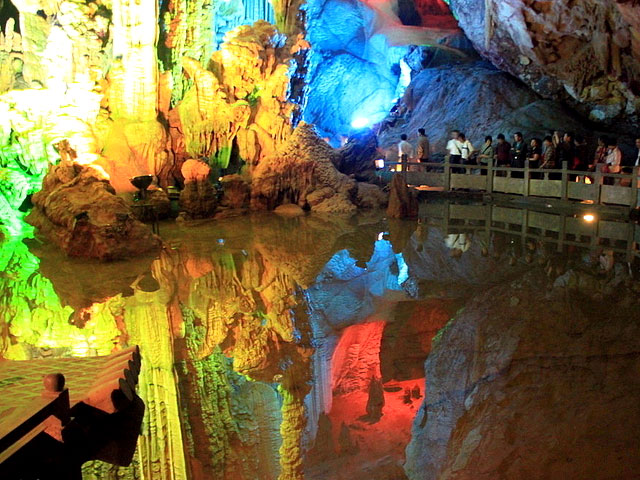
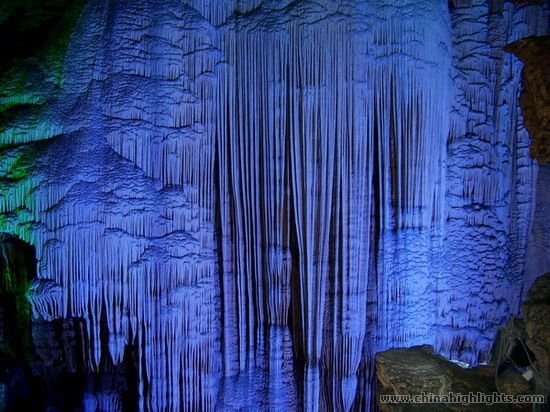
Stalactites stone is a miracle made by nature which contains chemical reaction process more than ten thousand years . Their visible shapes or sometimes a bit messy shapes combined with different color lights formed a beautiful attraction to visitors. They usually formed into four main types: Limestone stalactites, Lava stalactites, Ice stalactites and Concrete stalactites. There are three more types that count as lave stalactites which are Shark tooth stalactites, Splash stalactites and Tubular lava stalactites. When you enter the cave full of these stone, some people feel like they have entered haven but some people might feel a bit uncomfortable with this kind of stone. I have personally visit a stalactites stone cave, the beautiful the nature is the feeling that you can not explain by words. For a quick reminder, it might be cooler in the inside of the cave, so you might consider to bring a jacket when you planing on a trip to this kind of viewpoints.


Located in the southeast of Yangshuo, Silver Cave is a karst cave running through 12 mountains with a 2,000-meters-long roundabout course. Various stalactites developed in different geologic ages in Silver Cave constitute awe-inspiring scenery. 


Being a real fairyland, Silver Cave is a place where you will be greatly impressed by its high hollow sky, deep Underground River, impending waterfall and dense stalagmite. Walking inside the silver cave, you will exclaim how nature can be so powerful to make such magnificent sights. Silver top of the cave makes you feel in a in a beautiful world of ice, snow and frost. When you walked across the stone cliffs, you will understand why it is called silver cave as they are shiny like silver. Inside the cave, each scenic spot will make you feel what is called lifelike and vivid.
Currently, about 2 kilometers of the cave has been presented to tourists, which is divided into three parts: the upper cave, the grand hall, and the lower cave. The most famous among all the spots in the cave include the "Three Unique": "Musical Stone Screen", the "Deep Moon Palace" and the "Waterfall on the Snow Mountain"; and the "Three Treasures", "Buddha Expounding Classics", the "Solitary Pillar Propping up the Sky" and the "Pearl-decorated Umbrella". All the rocks in Silver Cave contain mineral crystal. When lighting illuminates the rocks, they reflect a silvery sheen and glint like silver. Hence the cave is turned into a splendid underground palace by these star-spangled stalactites. The stalactites in the cave can be divided into four types according to their ages: the old, the middle-aged, the young, and the infantile.

Admission fee: RMB 90 p/p;

Opening hours: 08:30- 17:30;

Location: Silver Cave is in Lipu County, 85 kilometers to the south of Guilin.

How to get there: 
1. Take a direct bus from Guilin Bus Station to Silver (7:00 - 18:30), for 2-hour drive.
2. There are regular buses operating (8:30 - 16:30) from Yangshuo to Silver Cave. 


Zhonglian (Nicole) Yang


Reference: http://www.guilinholiday.com/attraction-v1094-silver-cave
http://media-cdn.tripadvisor.com/media/photo-s/06/05/93/f1/silver-cave.jpg
http://images.chinahighlights.com/attraction/yangshuo/silvercave/silver-cave.jpg


The 25 Most Popular Travel Destinations In The World

Have you ever think about which country is best place for vacation? Well, I collected some information from a website that it ranks the 25 most popular travel place in the world for you. This is just to give you a general cognitive of what country you can choose for spending a nice vacation with your families, friends or yourself. If you ask me why do we travel, I can provide a tons of reasons, but for the most obvious reason, is to relax ourselves and experience new interesting thing from other cultures. It does spend quite a lot of money sometimes but after the journey ends, you will feel that it is totally worth it! 

TripAdvisor just announced the winners of its 2014 Travellers’ Choice awards for Destinations.
Millions of TripAdvisor users voted on their favourite destinations around the world — and Asia was the big winner this year.
Six of the top 25 spots on TripAdvisor’s list of the World’s Top Travel Destinations are in Asia, including new hotspots like Hanoi, Vietnam (#8); Siem Reap, Cambodia (#9); and Shanghai, China (#12). Of course perennial favourites like Rome and London made the list too, but the number one spot may surprise you.
Award winners were based on millions of TripAdvisor reviews of hotels, attractions and restaurants for different cities over a 12-month period.

#25 San Francisco, California

#24 Chiang Mai, Thailand
#23 Lisbon, Portugal
#22 Sydney, Australia
#21 Budapest, Hungary
#20 Bangkok, Thailand
#19 Cape Town Central, South Africa
#18 Chicago, Illinois
#17 Dubai, United Arab Emirates
#16 St. Petersburg, Russia
#15 Barcelona, Spain
#14 Buenos Aires, Argentina
#13 Florence, Italy
#12 New York City, New York
#11 Berlin, Germany
#10 Shanghai, China
#9 Siem, Reap Cambodia
#8 Hanoi, Vietnam
#7 Paris, France
#6 Marrakech, Morocco
#5 Prague, Czech Republic
#4 Beijing, China
#3 London, England
#2 Rome, Italy
#1 Istanbul, Turkey

Zhonglian (Nicole) Yang

Reference: http://www.businessinsider.com.au/tripadvisors-most-popular-travel-destinations-2014-4#1-istanbul-turkey-25